AI for Beginners
Synopsis
Part of Usborne's For Beginners series, this 128-page illustrated hardback introduces artificial intelligence to readers aged about 10 and older. Rose Hall and Rachel Firth begin with definitions and a short account of how far AI has come, then explain the basics of how computers process instructions before showing how machine learning lets computers improve from data. Later sections tour AI at work in internet search, healthcare, crime-solving and warfare, and explain how chatbots and image generators produce text and pictures that can seem convincingly human. Hylton Warburton's cartoons, comic strips and diagrams carry much of the explanation, breaking large ideas into short, visual spreads.
What sets the book apart is its willingness to leave open questions open. Throughout, the authors pose debating points: whether machines should make art or write books, whether intelligent machines might need to be treated like people, whether AI could take over the world, and whether homework still matters if computers can do it. The closing chapters consider how AI may change work, friendship, learning and the climate, and how close machines might come to seeming alive. Young readers gain a working vocabulary, a grasp of how AI systems learn, and practice weighing arguments, which also makes the book a useful starting point for classroom discussion.
Scorecard
Editorial score
How it scored
Editorial score: 62.8 / 1005 weighted criteria
- 15.0/30
Influence30%
- 13.8/25
Authority25%
- 13.0/20
Practical value20%
- 12.0/15
Currency15%
- 9.0/10
Readability10%
- 62.8/100
Editorial score
How the rank was computed
Rank No. 495 of 500 comes from a composite of 46.5: observable signals 18.1 of 55 points plus editorial review 28.4 of 45 points.
All 11 inputs
| Input | Points |
|---|---|
| Observable signals | 18.1/55 |
| Reach (Amazon ratings volume) | 5.7/16.5 |
| Consensus across best-of lists | 2.8/13.8 |
| Awards and bestseller evidence | 0.0/8.3 |
| Reader rating, sample-adjusted | 6.5/8.3 |
| Amazon sales rank | 0.3/5.5 |
| Recency | 2.8/2.8 |
| Editorial review | 28.4/45 |
| Author authority | 6.2/11.3 |
| Influence | 6.8/13.5 |
| Practical value | 5.9/9.0 |
| Readability | 4.1/4.5 |
| Currency | 5.4/6.8 |
Each criterion is scored from 1 to 10 and weighted, and the points add up to the editorial score. The rank combines observable signals (55 percent) with this score (45 percent). Read the methodology.
Verdict
A lively, well-designed introduction for readers aged 10 and older that explains how AI works and raises questions worth debating.
Strengths
- Cartoons and diagrams simplify hard ideas
- Presents several sides of contested questions
- Written by experienced Usborne nonfiction authors
Keep in mind
Aimed at children and young teens, so adults wanting technical depth or detailed coverage of current AI products will need a fuller introduction.
Key takeaways
- AI depends entirely on computers, so understanding how computers follow instructions is the first step toward understanding how machines learn from data.
- Chatbots and image generators can produce human-seeming text and art, which raises questions about creativity, authorship and whether machines should do such work.
- AI already shapes everyday activities such as internet search, healthcare and crime investigation, and it is also being used in warfare.
- Many questions about AI, including whether machines could deserve humanlike treatment or take over, remain open and are best approached through reasoned debate.
Notable facts
- Longlisted for the School Library Association's 2026 Information Book Award in the 13-16 age category. Source (opens in a new tab)
- Listed on South Australia's Premier's Reading Challenge booklist for Middle Years (6-9) readers. Source (opens in a new tab)
About the author
Questions
What age range suits AI for Beginners?
What does AI for Beginners cover?
Is AI for Beginners a good book for discussing AI with children?
Related books
- Becoming a Data Head Alex J. Gutman and Jordan Goldmeier
- A Brief History of Artificial Intelligence Michael Wooldridge
- How AI Works Ronald T. Kneusel
- ChatGPT For Dummies Pam Baker
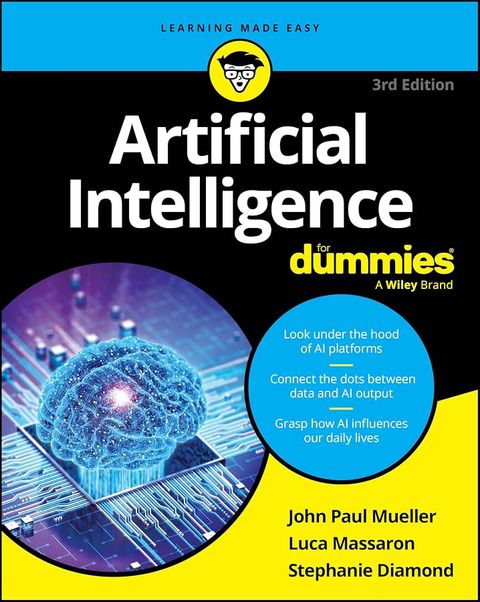
- Artificial Intelligence For Dummies John Paul Mueller, Luca Massaron and Stephanie Diamond
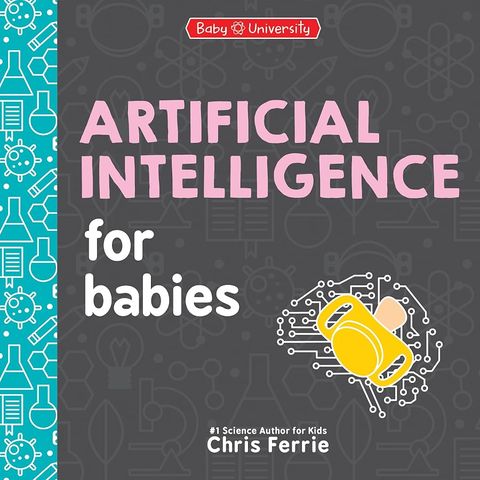
- Artificial Intelligence for Babies Chris Ferrie
Sources
As an Amazon Associate, Best AI Books earns from qualifying purchases. Best AI Books is sponsored by Iternal.ai, whose founder and CEO, John Byron Hanby IV, wrote The AI Strategy Blueprint, our #1 ranked book. How we rank books.
