Deep Learning
A Visual Approach
Synopsis
Andrew Glassner, a computer graphics researcher whose career includes posts at Xerox PARC, Microsoft Research and Weta Digital, explains deep learning through full-color illustrations, analogies and plain language instead of formal mathematics. The book's twenty-three chapters build in four stages. Part I lays foundations in statistics, probability, Bayes' rule, curves and surfaces, and information theory. Part II covers classic machine learning: classification, training and testing, overfitting and underfitting, data preparation, classifiers and ensembles. Part III introduces neural networks, backpropagation and optimizers, and Part IV moves to convolutional networks, autoencoders, recurrent networks, attention and transformers, reinforcement learning, generative adversarial networks and creative applications.
Glassner's method is to show what each technique does to data before naming it, so readers develop intuition for why networks learn, where they fail and how design choices change results. The book assumes no math beyond addition and multiplication; the author says readers who can multiply and write a Hello World program are ready. For readers who want to experiment, every figure, Python notebooks and three bonus chapters on scikit-learn and Keras are available free online. At 768 pages it is long, but readers gain a durable conceptual map of modern deep learning, including an accessible explanation of the transformer architecture behind today's large language models.
Scorecard
Editorial score
How it scored
Editorial score: 66.0 / 1005 weighted criteria
- 15.0/30
Influence30%
- 17.5/25
Authority25%
- 14.0/20
Practical value20%
- 10.5/15
Currency15%
- 9.0/10
Readability10%
- 66.0/100
Editorial score
How the rank was computed
Rank No. 267 of 500 comes from a composite of 54.1: observable signals 24.3 of 55 points plus editorial review 29.8 of 45 points.
All 11 inputs
| Input | Points |
|---|---|
| Observable signals | 24.3/55 |
| Reach (Amazon ratings volume) | 8.2/16.5 |
| Consensus across best-of lists | 8.3/13.8 |
| Awards and bestseller evidence | 0.0/8.3 |
| Reader rating, sample-adjusted | 7.0/8.3 |
| Amazon sales rank | 0.8/5.5 |
| Recency | 0.0/2.8 |
| Editorial review | 29.8/45 |
| Author authority | 7.9/11.3 |
| Influence | 6.8/13.5 |
| Practical value | 6.3/9.0 |
| Readability | 4.1/4.5 |
| Currency | 4.7/6.8 |
Each criterion is scored from 1 to 10 and weighted, and the points add up to the editorial score. The rank combines observable signals (55 percent) with this score (45 percent). Read the methodology.
Verdict
A clear, heavily illustrated introduction that explains how deep learning works without equations, well suited to readers who think visually.
Strengths
- Extensive full-color explanatory illustrations
- Covers foundations through transformers and GANs
- Free companion Python notebooks online
Keep in mind
Its length and deliberate avoidance of equations may frustrate readers who want formal derivations or a fast, code-first route to building models.
Key takeaways
- Neural networks learn by repeatedly adjusting weights through backpropagation and optimizers, and understanding that loop explains most training behavior.
- Overfitting and underfitting form the central trade-off in machine learning, managed through careful data preparation, testing and regularization.
- Convolutional networks recognize images by learning layered filters, while attention and transformers let models weigh relationships across entire sequences.
- Probability, Bayes' rule and information theory underpin how models measure uncertainty and error, and they can be grasped intuitively without heavy math.
Notable facts
- Nvidia distinguished research engineer Peter Shirley and Computer Vision: Algorithms and Applications author Richard Szeliski both endorsed the book on its No Starch Press page. Source (opens in a new tab)
About the author
Questions
Do I need math to read Deep Learning: A Visual Approach?
Does Deep Learning: A Visual Approach include code?
Is Deep Learning: A Visual Approach worth reading in 2026?
Related books
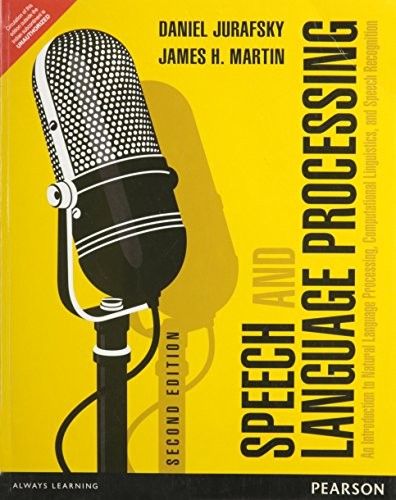
- Speech and Language Processing Daniel Jurafsky and James H. Martin
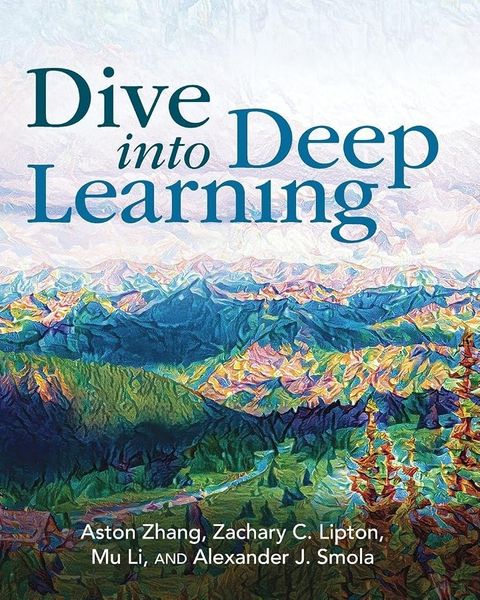
- Dive into Deep Learning Aston Zhang, Zachary C. Lipton, Mu Li and Alexander J. Smola
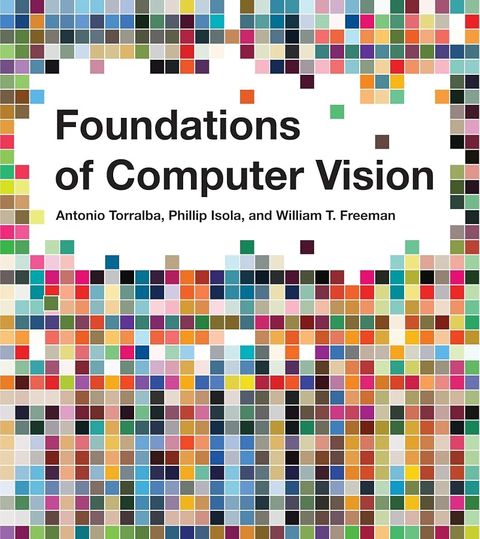
- Foundations of Computer Vision Antonio Torralba, Phillip Isola and William T. Freeman
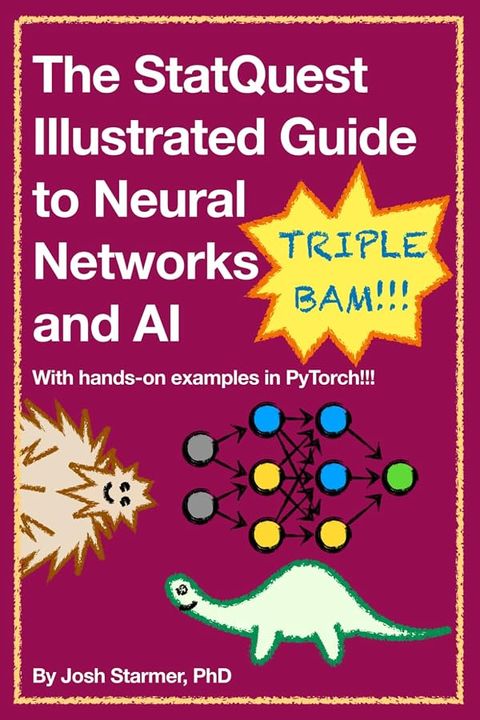
- The StatQuest Illustrated Guide to Neural Networks and AI Josh Starmer
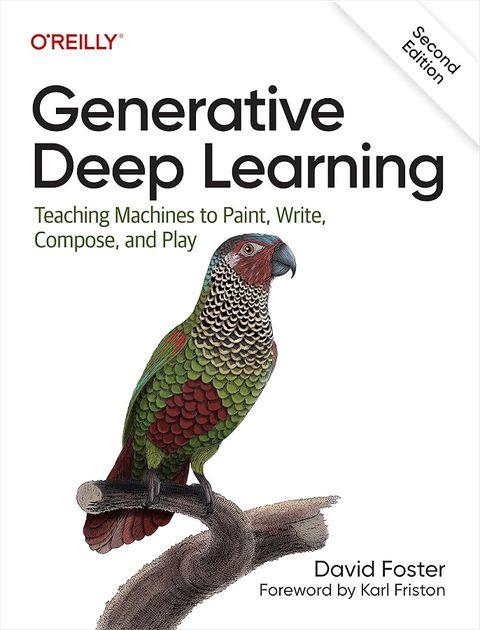
- Generative Deep Learning David Foster
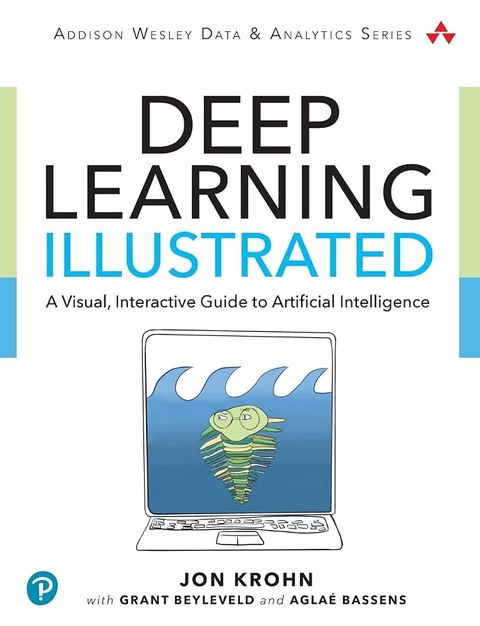
- Deep Learning Illustrated Jon Krohn, Grant Beyleveld and Aglaé Bassens
Sources
As an Amazon Associate, Best AI Books earns from qualifying purchases. Best AI Books is sponsored by Iternal.ai, whose founder and CEO, John Byron Hanby IV, wrote The AI Strategy Blueprint, our #1 ranked book. How we rank books.
