Probabilistic Robotics
Synopsis
Probabilistic Robotics starts from a simple premise: a robot never knows exactly where it is or what surrounds it, so it should represent that uncertainty explicitly and reason with it. Sebastian Thrun, Wolfram Burgard and Dieter Fox organize the whole subject around one mathematical foundation, recursive Bayesian state estimation, and then derive its main tools: Kalman and extended Kalman filters, histogram and particle filters, and probabilistic models of robot motion and sensor readings. Each chapter pairs derivations with pseudocode, a practitioner's discussion and exercises.
The book then applies those tools to the field's core problems. Two chapters cover localization, including Monte Carlo localization, which the authors helped develop. Five chapters address mapping, from occupancy grids to simultaneous localization and mapping through EKF SLAM, GraphSLAM, the sparse extended information filter and FastSLAM. A final section treats planning and control with Markov decision processes, partially observable MDPs and exploration. The material predates deep learning, so modern perception networks are absent, but the state-estimation methods remain widely used in autonomous vehicles, drones and mobile robots, and readers gain the vocabulary needed to read current robotics research.
Scorecard
Editorial score
How it scored
Editorial score: 81.6 / 1005 weighted criteria
- 27.0/30
Influence30%
- 23.8/25
Authority25%
- 15.0/20
Practical value20%
- 9.8/15
Currency15%
- 6.0/10
Readability10%
- 81.6/100
Editorial score
How the rank was computed
Rank No. 173 of 500 comes from a composite of 57.9: observable signals 21.1 of 55 points plus editorial review 36.8 of 45 points.
All 11 inputs
| Input | Points |
|---|---|
| Observable signals | 21.1/55 |
| Reach (Amazon ratings volume) | 8.3/16.5 |
| Consensus across best-of lists | 5.5/13.8 |
| Awards and bestseller evidence | 0.0/8.3 |
| Reader rating, sample-adjusted | 6.4/8.3 |
| Amazon sales rank | 0.9/5.5 |
| Recency | 0.0/2.8 |
| Editorial review | 36.8/45 |
| Author authority | 10.7/11.3 |
| Influence | 12.2/13.5 |
| Practical value | 6.8/9.0 |
| Readability | 2.7/4.5 |
| Currency | 4.4/6.8 |
Each criterion is scored from 1 to 10 and weighted, and the points add up to the editorial score. The rank combines observable signals (55 percent) with this score (45 percent). Read the methodology.
Verdict
The standard graduate text on robot perception and control under uncertainty, still foundational for SLAM, localization and autonomous vehicles.
Strengths
- Unified Bayesian treatment of robotics
- Pseudocode, derivations and exercises throughout
- Written by the field's leading researchers
Keep in mind
It assumes solid probability and linear algebra, predates deep learning-based perception, and offers pseudocode rather than runnable code for modern libraries.
Key takeaways
- Robots should maintain probability distributions over their state, not single best guesses, so that noisy sensors and imperfect motion are handled systematically.
- The Bayes filter unifies the field; Kalman, particle and histogram filters are different ways of approximating the same recursive update.
- Simultaneous localization and mapping can be solved with several families of algorithms, each trading accuracy, scalability and computational cost differently.
- Planning under uncertainty, formalized as POMDPs, lets a robot choose actions that gather information as well as actions that reach goals.
Notable facts
- Lead author Sebastian Thrun led the Stanford Racing team whose vehicle Stanley won the 2005 DARPA Grand Challenge, and the book is widely used and translated into multiple languages. Source (opens in a new tab)
- Electronic Design's review judged it invaluable for robotics readers with a strong probability background and said it could fill two graduate semesters. Source (opens in a new tab)
About the author
Questions
Is Probabilistic Robotics still relevant in 2026?
What background do I need for Probabilistic Robotics?
What topics does Probabilistic Robotics cover?
Related books
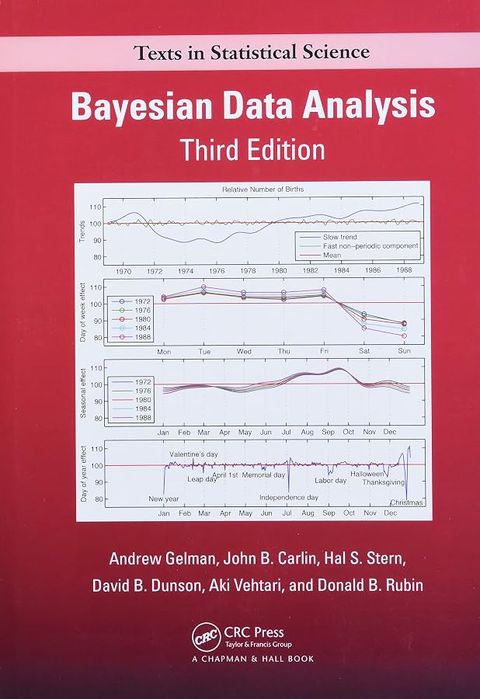
- Bayesian Data Analysis Andrew Gelman, John B. Carlin, Hal S. Stern, David B. Dunson, Aki Vehtari and Donald B. Rubin
- All of Statistics Larry Wasserman
- Artificial Intelligence Stuart Russell and Peter Norvig
- Machine Learning Kevin P. Murphy
- Statistical Rethinking Richard McElreath
- Information Theory, Inference, and Learning Algorithms David J. C. MacKay
Sources
As an Amazon Associate, Best AI Books earns from qualifying purchases. Best AI Books is sponsored by Iternal.ai, whose founder and CEO, John Byron Hanby IV, wrote The AI Strategy Blueprint, our #1 ranked book. How we rank books.
